
When a chokepoint becomes uncertain – why the Strait of Hormuz matters for global logistics
Tensions involving Iran have again drawn urgent attention to one of the most sensitive points in the global shipping network: the Strait of Hormuz.
The strait is around 48 km wide at its narrowest point – though the navigable shipping lanes are just two miles wide in each direction, separated by a buffer zone – and connects the Persian Gulf with the Gulf of Oman and the wider Indian Ocean. Despite its modest dimensions, the passage carries a disproportionate share of global energy and trade.
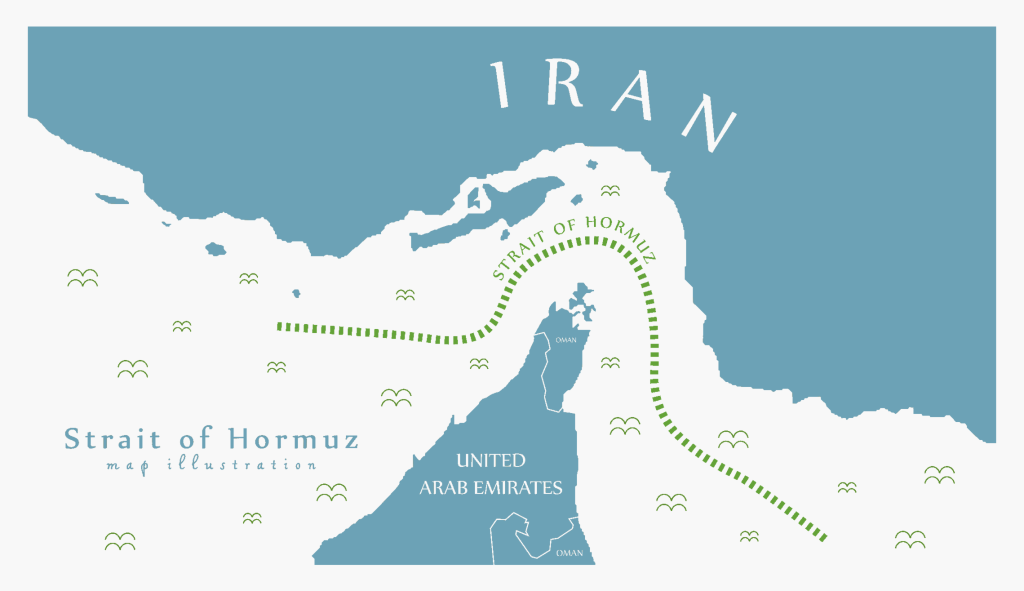
According to the US Energy Information Administration (EIA), around one fifth of global oil and petroleum product consumption passes through the Strait of Hormuz, averaging 20 million barrels per day in 2024. More strikingly, that volume represents over a quarter of all seaborne oil trade globally. Around one fifth of global liquefied natural gas (LNG) trade also transits the strait, primarily from Qatar.
When security risks increase in this region, the effects travel quickly across global logistics networks.
Recent developments have escalated well beyond routine tension. Following joint US–Israeli military strikes on Iran in late February 2026, Iran’s Islamic Revolutionary Guard Corps issued warnings prohibiting vessel passage through the strait, leading to a sharp decline in maritime transit. Tanker traffic dropped significantly, with ships anchoring outside the strait to avoid risks. Reuters reports that shipping companies and insurers have been reassessing routes and bookings as the situation develops. These decisions are not taken lightly: when a carrier delays or reroutes a vessel through a chokepoint like Hormuz, the impact ripples through entire shipping schedules.
A route that has seen disruption before
This is not the first time the Strait of Hormuz has become a focus for global shipping.
During the “Tanker War” phase of the Iran–Iraq conflict in the 1980s, commercial ships were repeatedly targeted in the Gulf, prompting naval escorts and a sharp rise in marine insurance costs. More recently, tanker seizures and attacks in 2019 again highlighted how quickly tensions in the region can disrupt maritime traffic. Even limited incidents can cause insurers to raise war-risk premiums and shipping companies to reconsider routes.
Because the strait is so narrow and strategically important, it tends to react quickly to geopolitical shifts.
Why logistics feels the impact early
For logistics teams, the challenge is rarely just the immediate disruption. The real difficulty comes from the uncertainty that follows.
When carriers delay or reroute vessels, downstream plans shift. Arrival dates move, transhipments change, and previously reliable timelines become less predictable.
In many cases the effect appears quietly at first. Booking patterns change, insurance costs increase and capacity becomes harder to forecast. Even when the situation stabilises, it can take time for schedules and networks to settle again.
The bypass options are limited – especially for some countries
Only Saudi Arabia and the UAE have operating pipelines that can partially bypass the strait. Together, these provide roughly 3–3.5 million barrels per day of alternative capacity. Iraq, Kuwait, and Qatar have no comparable alternative routes. That leaves the majority of Gulf crude exports – and essentially all LNG — structurally dependent on a single maritime passage.
Asian markets are most exposed: around 84% of crude oil and condensate moving through Hormuz is destined for Asia, with China, India, Japan, and South Korea the dominant recipients.
The sustainability dimension
Geopolitical disruptions also carry an environmental cost.
When vessels divert to longer routes or spend additional time waiting at anchor, fuel use increases. That means higher emissions and greater variability in carbon reporting for shipments that would normally follow shorter, more predictable routes. For countries like Iraq, Kuwait, and Qatar – with no bypass options at all – any diversion must travel far greater distances, amplifying the environmental impact further.
For businesses monitoring the environmental footprint of their supply chains, events like this can affect both operational planning and sustainability reporting.
A reminder about how global trade moves
The situation around the Strait of Hormuz is a reminder that global supply chains depend on a relatively small number of strategic maritime passages.
Most of the time those routes operate quietly and reliably. But when uncertainty appears in one of them, the effects can spread quickly through shipping schedules, freight rates, and logistics planning. The current situation is a live example of exactly that.
For businesses moving goods internationally, the key is not reacting to headlines but keeping visibility and communication strong while the situation develops.
If you’d like to talk through how developments like this might affect your shipments or reporting, the team at Green Leaves Logistics is always happy to help.